Last updated: 2 June 2026. Written by Tim du Toit, 39 years investing since 1987, founder of Quant Investing, author and published quant researcher.
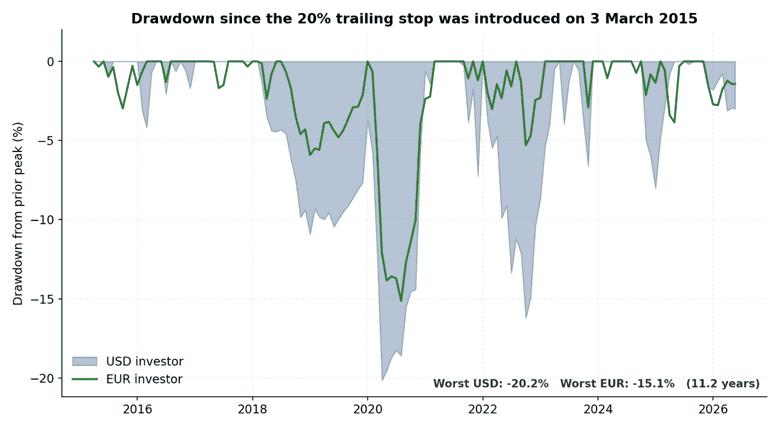
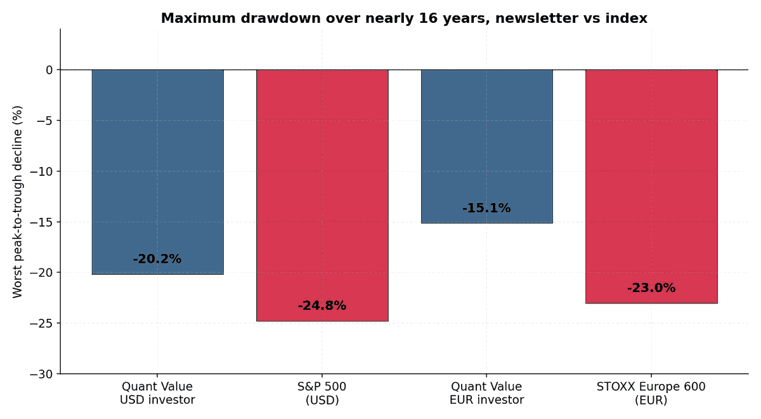
The Quant Value newsletter's worst peak-to-trough loss over the 11.2 years since the 20% trailing stop loss was introduced on 3 March 2015 was -20.2% for a US Dollar investor and -15.1% for a Euro investor. The S&P 500 lost -24.8% on monthly closes (and -33.9% intraday) over the same period. The STOXX Europe 600 lost -23.0% (-35.6% intraday). This article shows how those numbers were calculated, how long the bad stretches lasted, and the three risk-management rules that kept the loss smaller than the broad market. The full 671-idea history was run through our internal database linked to Claude AI.
Key facts at a glance. Quant Value newsletter started 10 July 2010, 671 ideas to date. 20% trailing stop loss introduced 3 March 2015. Post-rule period max drawdown: -20.2% USD / -15.1% EUR over 11.2 years. Total return +237% USD / +231% EUR. CAGR 11.4% USD / 11.3% EUR. S&P 500 lost -24.8% on monthly closes; STOXX Europe 600 lost -23.0% over the same period.
How I calculated this
Most subscribers are not professional investors, and the word "drawdown" can sound technical. It is not. Maximum drawdown is the worst peak-to-trough fall in your portfolio over the period you are looking at. If your account hit a high of 200,000 and then fell to 160,000 before recovering, your drawdown at the bottom was 20%.
The calculation does NOT just look at one bad month. It compares the portfolio value at each month-end to the highest value the portfolio had reached at any prior month-end. If the portfolio falls for three months in a row before recovering, the drawdown at the bottom of month three is the full compounded fall from the peak before the decline started.
Step by step
- Took every single buy and sell call the newsletter has ever made, 671 ideas, with the actual recommendation dates and the actual close dates.
- Started with a virtual portfolio of 100,000 on 10 July 2010, the date of the first recommendation.
- Bought every new recommendation at the closing price on the day the newsletter was published. Sold every position at the closing price on the day the newsletter told subscribers to sell, including sells from the 20% trailing stop loss rule.
- Sized every position at 2% of the portfolio value at the time of the buy.
- Added dividends to cash as they were paid and reinvested them into the next new pick.
- Converted every transaction to US Dollars using the exchange rate on that day, then ran the same calculation again converting to Euros.
- Took a snapshot of the portfolio value at the end of every month. Tracked the rolling peak. At each month-end, the drawdown is (current value / past peak) minus 1.
I did not include transaction costs, taxes, or buy-sell spread slippage.
The trailing stop loss was introduced on 3 March 2015
The 20% trailing stop loss is not something the newsletter has always followed. The first Quant Value newsletter recommendation went out on 10 July 2010. From then until 2 March 2015, there was no stop loss.
In January 2014 the newsletter recommended Afren PLC, a UK-listed oil and gas company. Over the course of 2014 it became clear that there was fraud at the senior management level. The shares fell 75%. It was a complete loss. That experience drove the introduction of the 20% trailing stop loss on 3 March 2015. Every idea recommended from that date forward has been subject to it. The rule is now 11.2 years old.
So when you look at the drawdown numbers below, it is important to look at what has happened over the 11.2 years since we added the 20% trailing stop loss rule that protects your downside.
The headline numbers: the era that had the rule
Here are the numbers that matter, restricted to the period when the 20% trailing stop loss has been in effect (3 March 2015 to 20 May 2026, 11.2 years):
| USD investor | EUR investor | |
|---|---|---|
| Period covered | 3 Mar 2015 to 20 May 2026 | 3 Mar 2015 to 20 May 2026 |
| Duration | 11.2 years | 11.2 years |
| Final NAV (start = 100,000) | 337,048 | 331,068 |
| Total return | +237% | +231% |
| CAGR (compound annual return) | 11.4% | 11.3% |
| Maximum drawdown | -20.2% | -15.1% |
| Annualised volatility | 10.5% | 8.0% |
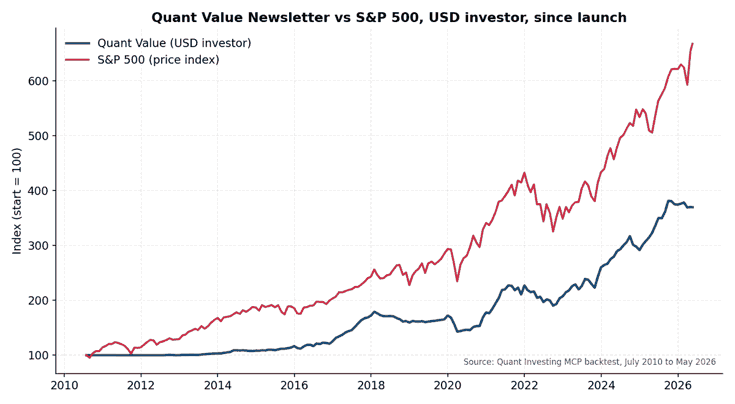
Over 11.2 years, two major market shocks (COVID in 2020 and the 2022 bear market), and the worst stretch the newsletter has put a subscriber through is a 20% loss in US Dollars or 15% in Euros from a prior peak. The Quant Value performance page carries the year-by-year breakdown.
See the rules behind these numbers in action
The Quant Value newsletter ships six undervalued global ideas the first Tuesday of every month. Each one is sized at 2% and runs the same 20% trailing stop loss discipline you just saw in the data. The first issue arrives in your inbox within minutes of subscribing.
100% money-back guarantee for the first 30 days.
How long did each bad stretch last?
A single max drawdown number hides a lot. The portfolio does not lose 20% in one bad month. It loses a little, then a bit more, then a bit more, before the bottom. Stock drawdowns are normal, and how they unfold matters as much as how deep they go.
Quant Value, USD investor: the four worst episodes
| Peak | Trough | Months | Depth | Recovery | Rec. months | Comment |
|---|---|---|---|---|---|---|
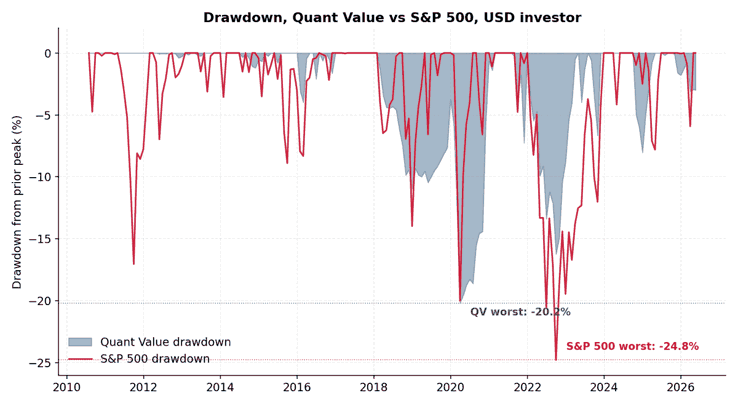
| Jan 2018 | Mar 2020 | 26 | -20.2% | Feb 2021 | 11 | Long, grinding decline through 2018-2019 culminating in the COVID crash. |
| Jul 2021 | Sep 2022 | 14 | -16.2% | Apr 2023 | 7 | The 2022 bear market. Inflation, rate hikes, broad equity selloff. |
| Sep 2024 | Dec 2024 | 3 | -8.0% | Apr 2025 | 4 | Late-2024 pullback. Short and shallow. |
| Jul 2023 | Oct 2023 | 3 | -6.6% | Nov 2023 | 1 | Q3 2023 rate-driven pullback. Recovered in one month. |
Look at the first row carefully. The worst stretch in the newsletter was not a one-month event. The portfolio peaked at $178,973 in January 2018, then ground sideways and lower through all of 2018 and 2019, and finally bottomed at $142,870 in March 2020 when COVID hit. That is a 26-month peak-to-trough decline of 20.2%. From there it took another 11 months to climb back above the January 2018 peak.
Quant Value, EUR investor: the four worst episodes
| Peak | Trough | Months | Depth | Recovery | Rec. months | Comment |
|---|---|---|---|---|---|---|
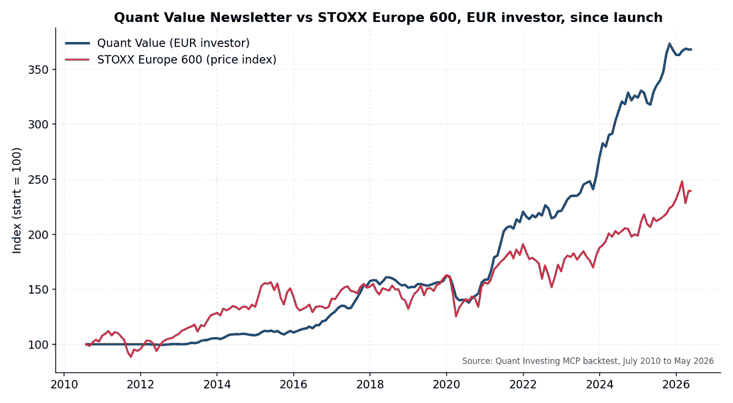
| Dec 2019 | Jul 2020 | 7 | -15.1% | Feb 2021 | 7 | COVID shock and slow recovery. |
| Jun 2018 | Dec 2018 | 6 | -5.9% | Dec 2019 | 12 | Second-half 2018 global pullback. 12-month recovery. |
| Jul 2022 | Sep 2022 | 2 | -5.3% | Jan 2023 | 4 | Tail end of the 2022 bear market. Much shallower for EUR than USD. |
| Jan 2025 | Apr 2025 | 3 | -3.9% | Jun 2025 | 2 | Early-2025 dip. |
For Euro investors the picture is shorter and shallower. The worst stretch was 7 months (December 2019 to July 2020, COVID), -15.1% deep, recovered in 7 more months.
S&P 500: how the index compares
| Peak | Trough | Months | Depth | Recovery | Rec. months | Comment |
|---|---|---|---|---|---|---|
| Dec 2021 | Sep 2022 | 9 | -24.8% | Dec 2023 | 15 | The 2022 bear market. Worst for the S&P 500. |
| Dec 2019 | Mar 2020 | 3 | -20.0% | Jul 2020 | 4 | COVID crash. Daily intraday low was about -33.9%. |
| Apr 2011 | Sep 2011 | 5 | -17.0% | Feb 2012 | 5 | European sovereign debt crisis. |
| Sep 2018 | Dec 2018 | 3 | -14.0% | Apr 2019 | 4 | Q4 2018 selloff. |
STOXX Europe 600: how the European index compares
| Peak | Trough | Months | Depth | Recovery | Rec. months | Comment |
|---|---|---|---|---|---|---|
| Dec 2019 | Mar 2020 | 3 | -23.0% | Mar 2021 | 12 | COVID crash. Daily intraday low was about -35.6%. |
| Feb 2011 | Sep 2011 | 7 | -21.1% | Jan 2013 | 16 | European sovereign debt crisis. |
| Dec 2021 | Sep 2022 | 9 | -20.5% | Feb 2024 | 17 | 2022 bear market. 17-month recovery. |
| May 2015 | Jun 2016 | 13 | -17.5% | Nov 2019 | 41 | Greek crisis, Brexit, prolonged weakness. 41-month recovery. |
So how do they compare on duration?
- QV USD worst: 26 months down to -20.2%, then 11 months recovery. Total underwater period: 37 months.
- S&P 500 worst (2022): 9 months down to -24.8%, then 15 months recovery. Total underwater period: 24 months.
- QV EUR worst: 7 months down to -15.1%, then 7 months recovery. Total underwater period: 14 months.
- STOXX 600 worst (COVID): 3 months down to -23.0%, then 12 months recovery. Total underwater period: 15 months.
Get the next month's Quant Value picks
The next Quant Value newsletter ships on the first Tuesday of the month with up to six new undervalued ideas screened from a global universe of 22,000 companies. Every existing position is reviewed against the 20% trailing stop, and any sells are flagged.
100% money-back guarantee for the first 30 days.
The US Dollar investor's experience
The Euro investor's experience
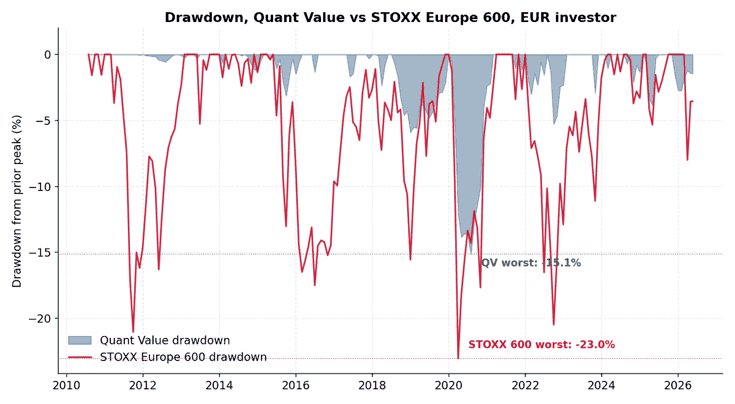
Why the Euro investor had a smaller worst loss
The newsletter buys companies all over the world. When global stocks fall, the US Dollar often strengthens because investors run to it for safety. A Euro investor holding non-Euro stocks gets a tailwind from the currency mix at exactly the moment when share prices are falling. The volatility in the Euro version of the portfolio (6.8% a year over the full period) was lower than in the US Dollar version (9.0% a year). For the same companies.
Rule 1: the 20% trailing stop loss, in detail
Once a month I check every position in the portfolio. If a stock has fallen more than 20% below its highest close since the buy, I tell you to sell. No exceptions, no waiting for it to come back.
The numbers are simple. A 20% loss needs only a 25% gain to get back to even. A 50% loss needs a 100% gain. Cut at 20%, and you keep the compounding clock ticking.
A loser the rule saved us from
Kernel Holding S.A. (Warsaw exchange, ticker KER). Ukrainian sunflower oil and grain. I recommended it on 2 March 2021 at PLN 54.70. Russia invaded Ukraine on 24 February 2022. The 20% trailing stop fired a week later. We sold on 1 March 2022 at a loss of 40.1%. Painful, but it stopped there. Today the stock trades at PLN 19.56. If we had held it, the loss would be 64%. The rule cut the loss by 24%.
A loser where the rule still hurt
Collection House Ltd. (Australia, ticker CLH.AX). Debt collector. Recommended 1 November 2019 at AUD 1.26. The stop got us out on 5 January 2021 at a loss of 65.5%. Worse than the typical 20% because the stock had run up first and then crashed in stages, with gaps. But the stock today is AUD 0.068. Holding to today would be a 94.6% loss. Even a brutal stop is still better than holding all the way down.
A winner where the rule did its other job
Johnson Electric Holdings (Hong Kong, ticker 0179). I recommended this on 7 January 2025 at HKD 10.94. By November 2025 it had nearly tripled. Then it started reversing. The 20% trailing stop fired on 2 December 2025 and locked in a return of 177.7%. The trailing stop does not only cut losses, it can also lock in gains as well as limit losses.
Rule 2: stop buying when the market is below its 200-day average
When the relevant regional market index is below its 200-day simple moving average, the newsletter does not add new ideas in that region. We hold what we own and we hold cash from any stop loss sales.
Across the 11.2 years since the trailing stop was introduced, the SMA rule kept us out of 7 specific buy ideas. Not many, because the rule only applies during sustained downtrends. But each one was a buy I would have made into a falling market.
When the market falls more than 20% to 30%, the newsletter opens a separate crash portfolio with ideas chosen for the recovery.
Why I size every position at 2% (and not more)
On a portfolio where each idea is 2% of your money, a 60% loss costs you 1.2% of the total. On a portfolio where each idea is 10%, the same 60% loss costs 6%. That changes your behaviour. It makes you sell good ideas at the wrong time.
I size positions small because the strategy is what makes money, not the individual companies. See the deeper write-up: why 2% per stock is smart. Across 474 ideas in the post-rule era, 49% have been winners (average +44%) and 51% losers (average -13%, because the stop cuts them short). That is the profit engine.
Three real winners
| Company (Country) | Bought / Sold | Return | Why it worked |
|---|---|---|---|
| Celestica Inc. (Canada) | May 2023, sold May 2024 | +317.5% | Canadian electronics manufacturing. Bought because it was cheap. Held a year. Sold when the value criteria broke. |
| AlzChem Group AG (Germany) | Apr 2024, sold Apr 2025 | +165.6% | Sleepy specialty chemicals. Profited from the European defence spending push after the Ukraine invasion. |
| Johnson Electric (Hong Kong) | Jan 2025, sold Dec 2025 | +177.7% | Tripled in 11 months on AI infrastructure demand. The 20% trailing stop sold us out near the top. |
Three real losers
| Company (Country) | Bought / Sold | Loss with stop | If we had held |
|---|---|---|---|
| Kernel Holding (Ukraine, Warsaw listing) | Mar 2021, sold Mar 2022 | -40.1% | Today: -64.2%. Stop cut the loss by 24%. |
| Collection House (Australia) | Nov 2019, sold Jan 2021 | -65.5% | Today: -94.6%. Stop cut the loss by 29%. |
| Monash IVF Group (Australia) | Sep 2019, sold Apr 2020 | -57.1% | Today: -31.4%. The price of running a rule. |
The 80/20 of all of this
- Size every position at 2%. Not 5%, not 10%.
- Apply the 20% trailing stop loss every month.
- When the regional index is below its 200-day simple moving average, hold cash and the crash portfolio.
What I want you to take away
Volatility is the fee you pay for returns above inflation. The job is not to avoid it. The job is to keep it small enough that you do not sell at the wrong time. Over the 11.2 years since the 20% trailing stop was introduced, the newsletter's worst stretch was a 20% loss for a US Dollar investor and a 15% loss for a Euro investor. The market lost more. The longer view is the same story: 15-year market outperformance.
Take a breath. Remember why you started. Now back to the system.
Your, keeping drawdowns low analyst.
Apply this risk discipline with the next pick
Quant Value subscribers get the screening, the position-sizing rule, the monthly 20% trailing stop check, and the 200-day SMA market filter applied for them on every idea. The performance page shows the full track record since 2010 with no edits.
100% money-back guarantee for the first 30 days.
Frequently asked questions
What is the maximum drawdown of the Quant Value newsletter?
Over the 11.2 years since the 20% trailing stop loss was introduced on 3 March 2015, the Quant Value newsletter's maximum peak-to-trough drawdown was -20.2% for a US Dollar investor and -15.1% for a Euro investor. The drawdown is measured on month-end portfolio values and aggregates any consecutive losing months between the peak and the trough.
How long did the worst drawdown last?
For a US Dollar investor the worst drawdown was a 26-month decline from January 2018 to March 2020 (the COVID bottom), followed by 11 months to recover the prior peak. Total underwater period: 37 months. For a Euro investor the worst drawdown was 7 months from December 2019 to July 2020, with 7 months to recover. Total underwater period: 14 months.
How does Quant Value compare to the S&P 500 and STOXX Europe 600?
Over the 11.2 years from 3 March 2015 to 20 May 2026 on monthly closes, the S&P 500's maximum drawdown was -24.8% and the STOXX Europe 600's was -23.0%. Quant Value's drawdown was -20.2% in US Dollars and -15.1% in Euros. The newsletter cut roughly a third off the index drawdown for a Euro investor while still earning 11.3% a year.
When was the 20% trailing stop loss introduced?
On 3 March 2015, after the Afren PLC fraud that produced a -75% single-position loss in 2014. Every Quant Value pick recommended since 3 March 2015 has been subject to the rule, which is reviewed monthly: if a stock closes more than 20% below its highest close since the buy, the newsletter recommends selling.
Do stop losses always work?
No, and the article shows both cases. Collection House Ltd. gapped down hard and the stop only fired at -65%, not -20%. Monash IVF's stop fired at the COVID lows in April 2020 and the stock has since partially recovered, so the rule sold us low. But the average loser in the post-rule era is only -13%, because the stop cuts most failed positions short. For more cases see more truths about stop losses.
Why size each position at 2% and not more?
Because the strategy is what makes money, not the individual company. On a portfolio where each idea is 2% of your money, a 60% loss costs you 1.2% of the total. On a portfolio where each idea is 10%, the same 60% loss costs 6%. The deeper write-up: why 2% per stock is smart. Across 474 closed Quant Value ideas in the post-rule era, 49% were winners (average +44%) and 51% losers (average -13%, because the stop caps them).
How are the picks chosen?
Each month the Quant Value model screens the global stock universe for undervalued quality companies and the newsletter recommends the strongest six ideas. The full process is documented here: how we select Quant Value ideas.
Where did the numbers in this article come from?
They come from a backtest of every Quant Value pick from 10 July 2010 to 20 May 2026, run through our Quant Investing MCP. The full per-month NAV series, the drawdown episode breakdown, and every stock example with entry and exit dates are available in the supporting spreadsheet.