
Last updated: April 2026
Tim du Toit has been investing since 1987 (39 years) and is the author of Quantitative Value Investing in Europe: What Works for Achieving Alpha.
Over 80 years of US stock market history, buying the top 10% of large caps ranked by shareholder yield beat the market in 97% of rolling 10-year periods, outperforming by 3.41% per year on average. That is the headline result from Jim O'Shaughnessy's 1927–2009 study. Five other independent back tests, covering Europe and the US across time windows from 12 to 32 years, reach the same answer.
Shareholder yield is dividends plus net stock buybacks — the two ways a company can return cash to the people who own it. A pure dividend screen misses the buyback half, and the data below shows exactly how much that costs you.
Here is the evidence, and the exact screen to find these companies in under five minutes.
Shareholder Yield — definition:
Shareholder yield measures the total cash a company returns to shareholders as a percentage of its market value. It combines three components: dividend yield + net stock buyback yield + debt reduction yield. Formula: (Dividends Paid + Net Buybacks + Net Debt Reduction) ÷ Market Capitalisation.
Key findings from 80+ years of back tests:
- Top 10% shareholder yield companies beat the market 97% of the time over rolling 10-year periods (O'Shaughnessy, 80-year study 1927–2009)
- Average annual outperformance: 3.41% per year over rolling 10-year periods
- Adding high-conviction buybacks (>5%) increased annual returns from 16.44% to 17.59% — a 232.5% improvement over 17 years
- Maximum drawdown 50% lower than a pure dividend yield strategy (JP Morgan Cazenove, 2000–2012)
- Works in both the USA and Europe across multiple time periods
Shareholder yield vs dividend yield: what the data shows
Most income investors look at dividend yield in isolation. That misses the two other ways a company can return cash to its owners.
Dividend yield only counts cash paid as dividends. Shareholder yield adds net stock buybacks, shares the company repurchases from the market, which concentrates ownership in the shareholders who remain. An expanded variant, used by Mebane Faber, adds a third component: net debt reduction, which transfers enterprise value from lenders to equity holders.
On the Quant Investing screener these are two separate ratios:
- Shareholder Yield — dividends + net buybacks (the standard two-component definition used in O'Shaughnessy's 80-year back test and OSAM's 32-year back test)
- Shareholder Yield (MB) — dividends + net buybacks + net debt reduction (Mebane Faber's three-component definition, also used by JP Morgan Cazenove)
A company paying a 2% dividend while also repurchasing 4% of its shares has a Shareholder Yield of 6%, not 2%. A pure dividend screen misses that company entirely.
Two studies quantify why this matters. Paul Novel's 17-year US test (1999–2016) found that a Shareholder Yield screen returned 16.44% per year, rising to 17.59% when filtered for companies buying back more than 5% of their shares, a 232.5% improvement in total return over 17 years. JP Morgan Cazenove's 12-year Europe and US study (2000–2012) found that replacing dividend yield with Shareholder Yield (MB, the three-component version) cut the maximum drawdown in half while raising annual returns.
| Component | Dividend Yield | Shareholder Yield | Shareholder Yield (MB) |
|---|---|---|---|
| Cash dividends paid | Yes | Yes | Yes |
| Net stock buybacks | No | Yes | Yes |
| Net debt reduction | No | No | Yes |
| Back tests supporting it | Used as comparison in all four studies | O'Shaughnessy 80-yr, OSAM 32-yr, Novel 17-yr | JPM Cazenove 12-yr, Faber 15-yr |
| Tax efficiency for investors | Lower — dividends taxed on receipt | Higher — buybacks defer tax to sale | Higher — same as Shareholder Yield |
Start with the standard Shareholder Yield ratio. It is the version with the longest and strongest back-test record. Switch to Shareholder Yield (MB) only if you specifically want to weight debt-reducing companies more heavily in your screen.
Run a shareholder yield screen on any market in minutes
The screener has a pre-computed Shareholder Yield column that already combines dividend yield and net buyback yield into a single ranking. Pick your countries, sort by Shareholder Yield from highest to lowest, and you have a starting list in under a minute. No sliders to set, no ratios to combine by hand. The Shareholder Yield (MB) column is there too if you want Faber's three-component version.
Run a shareholder yield screen
No credit card needed. Cancels automatically after 30 days.
What is a shareholder yield investment strategy?
The shareholder yield investment strategy uses the three ways a company can return cash to shareholders:
- Cash dividends,
- Stock repurchases and
- Debt reduction,
to find investment ideas.
Who invented it?
According to Wikipedia the term shareholder yield was first used by William W. Priest of Epoch Investment Partners in a 2005 paper called The Case for Shareholder Yield as a Dominant Driver of Future Equity Returns.
Shareholder yield was also mentioned in the 2007 book, Free Cash Flow and Shareholder Yield: New Priorities for the Global Investor, by William Priest and Lindsay McClelland.
So does a shareholder yield investment strategy work?
I am sure before you start using the shareholder yield investment strategy you want to make sure that it works.
So let’s look at the back test results.
Back test #1 – 80 Year back test of shareholder yield in the USA
In the great September 2017 article 7 Traits for Investing Greatness Jim O'Shaughnessy summarised an 80 year (1927–2009) back test of the shareholder yield investment strategy.
In the article Jim wrote:
“In the stock market, I believe the surest way forward is to look at the long-term results for an investment strategy and how often — and by what magnitude — it beat its underlying benchmark.”
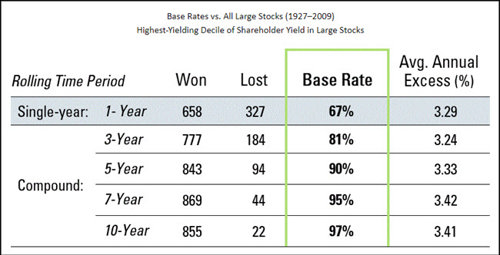
The following table shows you the results of simply buying the 10% of large stocks with the highest Shareholder Yield (dividend yield plus net stock buybacks) over an 80-year back test period:
Source: 7 Traits for Investing Greatness
| Rolling period | Periods tested | Beat market | Average outperformance |
|---|---|---|---|
| 3-year rolling | 961 periods (777 + 184) | 81% | +3.24% per year |
| 10-year rolling | 877 periods (855 + 22) | 97% | +3.41% per year |
Source: Jim O'Shaughnessy, 7 Traits for Investing Greatness, September 2017. Shareholder Yield defined as dividend yield plus net stock buybacks.
As you can see, over all 961 (777+184) rolling 3-year periods, the top 10% Shareholder Yield companies beat other large stocks 81% of the time by an average 3.24% per year.
If you extend the test to all 877 (855+22) rolling 10-year periods, you would have beaten the market 97% of the time by 3.41% per year.
That is an outstanding result!
Back test #2 – How to improve the shareholder yield investment strategy 17 year US back test
In the article Quant investing: improving the value of shareholder yield my friend Paul Novel tested the shareholder yield investment strategy in in the US markets over the 17 year period from 1999 to 2016.
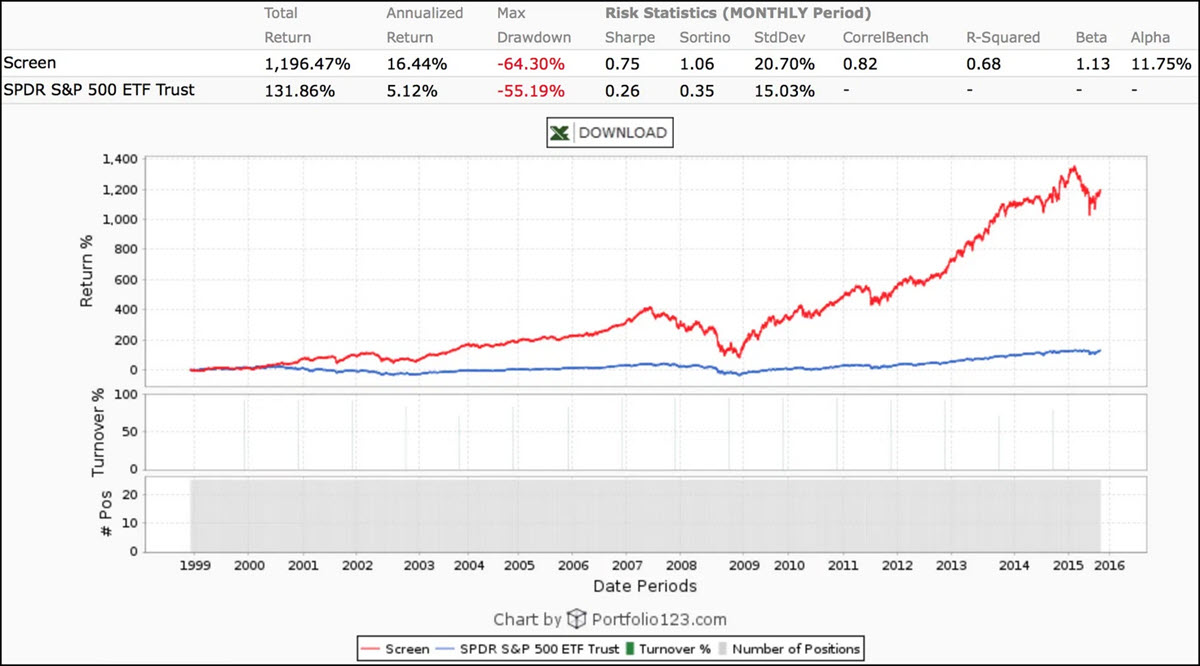
He first tested a high shareholder yield investment strategy against the S&P 500 over 17 years. This is what he found:
Click Image to enlarge
Source: Quant investing: improving the value of shareholder yield
| Metric | High Shareholder Yield portfolio | S&P 500 |
|---|---|---|
| Annual return (17 years) | 16.4% per year | 5.1% |
| Sharpe ratio | 0.75 | 0.26 |
| Sortino ratio | 1.06 | 0.35 |
Source: Paul Novel, Quant investing: improving the value of shareholder yield, investingforaliving.us, November 2015. Shareholder Yield defined as dividends + net stock buybacks.
As you can see the strategy outperformed the S&P 500 quite nicely earning 16.44% per year since 1999 with a Sharpe ratio of 0.75 and Sortino ratio of 1.06.
Adding high conviction buy backs
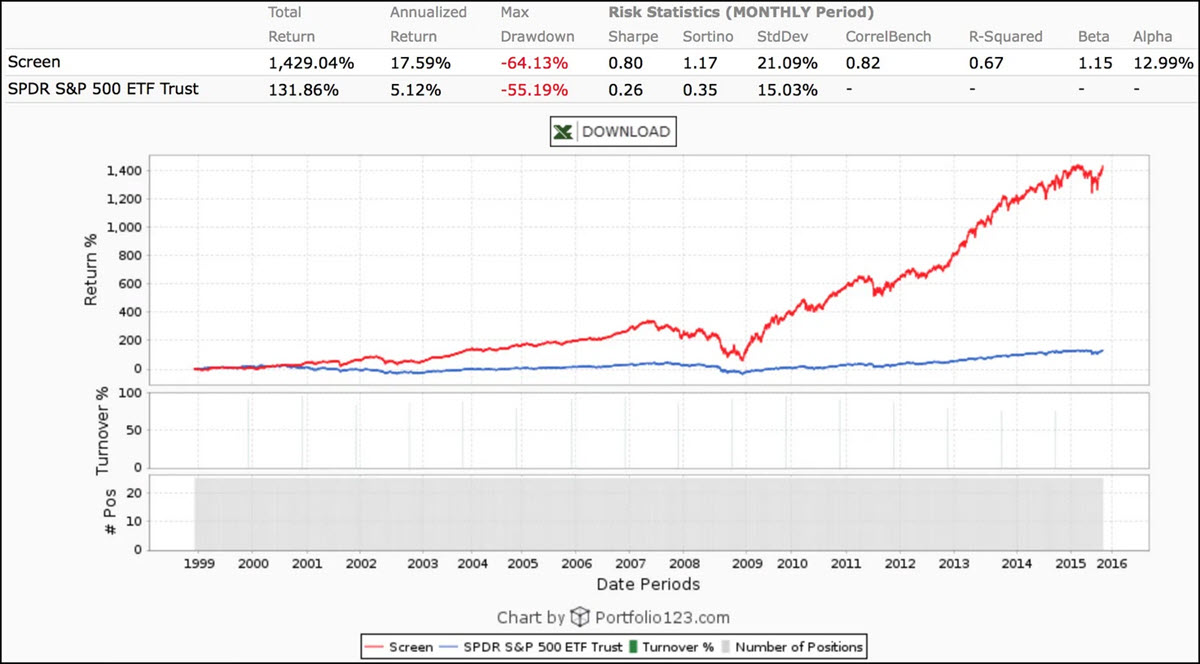
Paul then tested the same strategy but included only companies making high conviction stock buybacks which means they have a buyback yield greater than 5%.
Here are the results:
Click Image to enlarge
Source: Quant investing: improving the value of shareholder yield
| Metric | Base Shareholder Yield screen | With buyback yield > 5% filter |
|---|---|---|
| Annual return (17 years) | 16.44% | 17.59% |
| Total cumulative return | 1,196.5% | 1,429.0% |
| Improvement in total return | +232.5% over 17 years from a 1.15% annual return improvement | |
Source: Paul Novel, Quant investing: improving the value of shareholder yield, investingforaliving.us, November 2015.
As you can see yearly returns increased 1.15% from 16.44% to 17.59% per year since 1999. This may not sound like a lot but it is. Remember the increase is a "yearly increase" over 17 years. It results in the overall return increasing from 1196.5% to 1429% a 232.5% improvement over the 17 years.
As you can see, screening for high conviction buybacks (>5%) is a great improvement to the large cap shareholder yield investment strategy.
Back test #3 – 32 Year Shareholder Yield US Large Cap Value investment strategy back test
In the September 2019 research paper called Shareholder Yield: A Differentiated Approach to an ‘Efficient’ Market – US Large Cap Value O’Shaughnessy Asset Management tested the Shareholder Yield investment strategy over 32 years.
They also tested a few improvements you can make to the strategy.
Back test definitions
In the back test they defined the indicators they tested as follows:
- Shareholder Yield is the sum of a stock’s dividend yield (paid over previous twelve months minus special dividends) and the percentage of net share buybacks over the previous twelve months.
- Quality earnings = Year over year percentage change in total accruals.
How the Shareholder Yield investment strategies performed
The following charts show the 32 year growth of $1 invested in 1982 in the following four large cap investment strategies:
- S&P 500
- Top 10% of large stocks by Dividend Yield
- Top 10% of large stocks by Shareholder Yield (dividends + buybacks)
- Top 10% of large stocks by Shareholder Yield after eliminating the half of the stock universe with the highest valuation and poorest quality
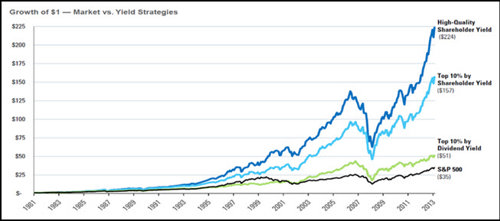
Source: Shareholder Yield: A Differentiated Approach to an ‘Efficient’ Market – US Large Cap Value
| Strategy | Ratio used | Growth of $1 over 32 years |
|---|---|---|
| S&P 500 | Market benchmark | $35 |
| Top 10% Dividend Yield | Dividend yield only | $51 |
| Top 10% Shareholder Yield | Dividends + net buybacks | $157 |
| Top 10% Shareholder Yield, quality + value filtered | Dividends + net buybacks, after removing half the universe for poor quality and high valuation | $224 |
Source: O'Shaughnessy Asset Management, Shareholder Yield: A Differentiated Approach to an 'Efficient' Market – US Large Cap Value, September 2019. Shareholder Yield defined as dividend yield (trailing 12 months, excluding special dividends) + net share buyback yield.
As you can see a shareholder yield investment strategy works, with quality undervalued shareholder yield companies generating the best returns.
Back test #4 – What if you replace Dividend Yield with Shareholder Yield
JP Morgan Cazenove in their 23 April 2013 publication Quant Forensics: Volume 5 Europe Equity Research researched if replacing Dividend Yield with Shareholder Yield could improve the performance of a defensive investment strategy.
They defined shareholder yield as (dividends + net debt change + Net repurchases) / Market Value - and tested the strategy over the 12 year period from 2000 to 2012.
Here are the results of shareholder yield compared to dividend yield investment strategy in Europe and the USA.
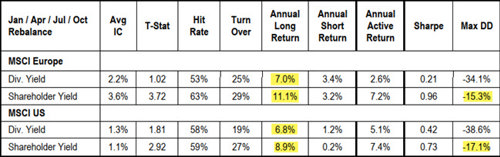
Source: JP Morgan Cazenove 23 April 2013 Quant Forensics: Volume 5 Europe Equity Research
| Region | Metric | Dividend Yield | Shareholder Yield |
|---|---|---|---|
| Europe | Annual long return | 7.0% | 11.1% |
| Europe | Maximum drawdown | -34.1% | -15.3% 50% lower |
| USA | Annual long return | 6.8% | 8.9% |
| USA | Maximum drawdown | -38.6% | -17.1% |
Source: JP Morgan Cazenove, Quant Forensics: Volume 5 Europe Equity Research, 23 April 2013. This study used the expanded Shareholder Yield definition: (dividends + net debt change + net repurchases) ÷ market value. On the Quant Investing screener this matches the Shareholder Yield (MB) ratio. The standard Shareholder Yield ratio uses dividends + net buybacks only.
Returns up 50% max draw down down 50%
As you can see annual long returns increased substantially compared to a dividend yield investment strategy. Also the maximum drawdown declined by 50%.
What is not to like about that!
Back test #5 – 15 year US Shareholder Yield Large Cap investment strategy back test
George at Fat Pitch Financials in an article called Mebane Faber Shareholder Yield Backtest tested the shareholder yield investment strategy over the 15 year period from 2000 to 2015.
George defined shareholder yield as = (Dividends Paid TTM + (Total Debt PYQ – Total Debt Q) + (Equity Purchased TTM – Equity Issued TTM))/ Market Capitalization
TTM = Trailing 12 months
PYQ = Prior year quarter
Q = This quarter
He also set the following screening criteria:
- No OTC stocks. Stocks not traded on the New York Stock Exchange, NASDAQ, or American Stock Exchange markets are excluded.
- No ADRs. Fundamental data for foreign American Depository Receipt can include errors due to currency exchange, different accounting standards, and share count.
- Liquidity test. The minimum daily total amount traded over the past 42 trading days must be larger than $100,000.
- Market Cap > $50 million. Nano cap stocks are excluded to help improve data quality. This filter also ensures that positions in a modest sized portfolio never exceed one percent of shares outstanding or the available float for a company.
- Price > $1. True penny stocks are excluded due to various information issues and manipulation of these stocks.
- Shareholder Yield = NA. He wanted to make sure he was only looking at companies that have valid data for the components of shareholder yield.
As you can see in the chart below the top 20% of stocks as ranked by shareholder yield (Screen or red line in the chart) outperformed the benchmark over the 15 year period from 2000 to 2015.
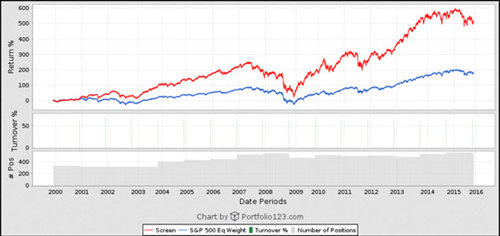
| Portfolio | Definition used | Total return, 2000–2015 |
|---|---|---|
| Top 20% Shareholder Yield screen | Dividends + net debt reduction + net buybacks (Faber) | +510% — outperformed |
| Benchmark | US market index | +198% |
Source: George at Fat Pitch Financials, Mebane Faber Shareholder Yield Backtest. Screening criteria: Market cap > $50m, price > $1, no OTC, no ADRs, minimum $100,000 daily traded value. On the Quant Investing screener this Faber definition matches the Shareholder Yield (MB) ratio, not the standard Shareholder Yield ratio.
Back test #6 – Do long-term shareholder yield calculations increase returns?
In June 2014 AlphaArchitect published an interesting research paper Shareholder Yield: Do longer-term calculations enhance performance?
In the paper they wanted to find out if a shareholder yield calculated over a longer period, up to eight years, increased returns compared to the normal one year historical calculation.
They selected stocks that they could calculate a shareholder yield value for 8 years and back tested a look-back period of between 1 and 8 years.
A one year look-back had 1 value, while an 8 year look-back had 8 values. These numerators are then divided by the current market price to generate a shareholder yield measure.
Details of the back test:
- Portfolios are formed on June 30th each year and held for one year
- They tested 1yr, 2yr, …8yr versions of shareholder yield
- They formed quintile portfolios (20% of companies) based on the shareholder yield average (Quintile 5 is high yield, Quintile 1 is low yield).
- Returns are buy-and-hold, with a 1% management fee.
This is what they found:
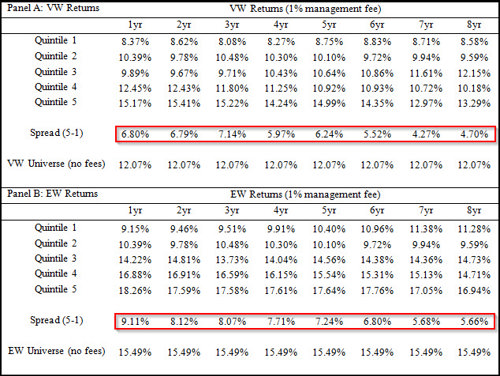
| Look-back period used | Spread: Quintile 5 (high yield) minus Quintile 1 (low yield) - EW |
|---|---|
| 1 year (trailing 12 months) | 9.1% — highest spread |
| 2 years | 8.1% |
| 3 years | 8.1% |
| 4 years | 7.7% |
| 5 years | 7.2% |
| 6 years | 6.8% |
| 7 years | 5.7% |
| 8 years | 5.7% — lowest spread |
Source: AlphaArchitect, Shareholder Yield: Do longer-term calculations enhance performance?, June 2014. Quintile portfolios formed annually on 30 June, held one year, 1% management fee. Conclusion: the one-year trailing shareholder yield produced the best spread; longer look-backs reduced it.
Overall, long-term shareholder yield calculations lowered performance, as you can see by the difference between high (Quintile 5) and low (Quintile 1) shareholder yields decreases as you use longer-term shareholder yield (look at row Spread 5-1).
So as you can see there is no benefit to using longer-term shareholder yield ratios. You can thus say that a company’s longer term shareholder yield track record counts for nothing when it comes to returns.
Summary and Conclusion
Before I show you exactly how to implement a shareholder yield investment strategy in your portfolio let’s look at what you can learn from all the above back tests:
- It works best for large companies
- Looking for high conviction buyback yield (greater than 5%) increases returns
- Selecting only from the 50% of companies with quality earnings (lowest year over year percentage change in total accruals) increases returns
- Selecting only from the 50% of companies with the lowest valuation increases returns
- The shareholder yield investment strategy outperforms the market in the USA and in Europe
- A high shareholder yield investment strategy substantially outperforms the market and has lower maximum drawdowns than a dividend yield investment strategy
- Long term shareholder yield calculations do not add to returns. Use trailing 12 months
How to implement a shareholder yield strategy in your portfolio
The Quant Investing stock screener makes it very easy to find high Shareholder Yield companies.
We have saved everything for you
To make it even easier we have already saved a screen, with all the ideas mentioned above for you.
All you have to do is load the screen with a few mouse clicks. This is how you do it:
- Log into the screener
- Click on the screener icon (small funnel) at the top left of the page
- Click the Load button
- Click the Predefined screeners tab
- Scroll down until you find the Shareholder Yield screen, click on it
- Click the Confirm button to load the screen
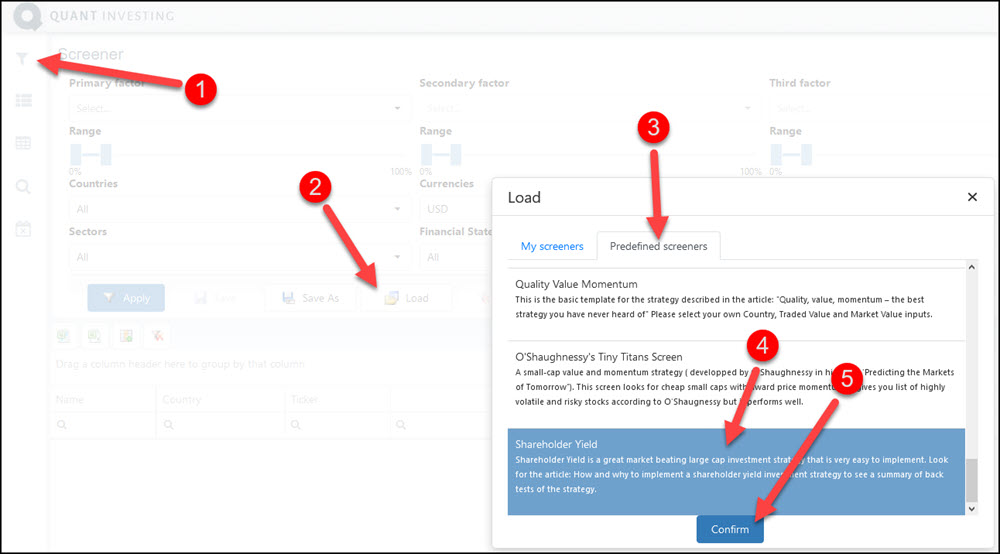
Click image to enlarge
Change it to exactly meet your needs
You can of course change the above screen to exactly meet your needs.
For example you can:
- Choose only the countries where you invest
- Choose only the industry sectors you want to see
- Change the minimum daily traded value
- Change the minimum company market value
- Back test your strategy, using the exact screen you set up
- Research any company that comes up in your screen
- Choose only the output columns you want to see
- Get email updates as soon as a new company fits the your screen
Remember to save your screen after making all the changes. Use the Save As button.
Add shareholder yield yourself
You can of course add Shareholder Yield to your investment strategy by simply selecting Shareholder Yield as one of your filters from the drop down list.
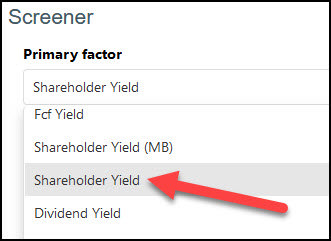
Then use the slider to select the highest Shareholder Yield companies, the highest 30% (0% to 30%) is selected in the image below.
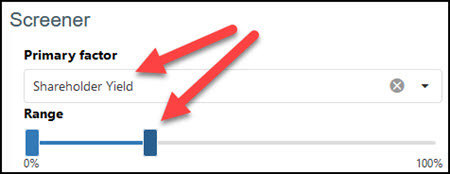
You can also use Shareholder Yield (MB) which is Mebane Faber’s definition of Shareholder Yield and includes debt repayments.
Get the exact definition
To see exactly how all the ratios and indicators are calculated and how to use them click the following link glossary.
Build your own shareholder yield portfolio in the free demo
The demo gives you the full screener with data from about a year ago. Sort any country or region by Shareholder Yield, take the top 30 names, and you have a starting portfolio built on the same logic as O'Shaughnessy's 80-year back test. The data age is useful here - the list the screener produces today is what the strategy would have picked 12 months ago, so you can pick any five names, check today's price, and see for yourself how the last year played out. Five minutes, real stocks, no back-test software needed.
Open the shareholder yield screener
No credit card needed. Cancels automatically after 30 days.
Frequently Asked Questions About How and why to implement a shareholder yield investment strategy
1. What is a shareholder yield investment strategy, and how does it work?
Shareholder yield measures the total cash a company returns to shareholders as a percentage of its market value. The standard formula is dividends paid plus net stock buybacks, divided by market capitalisation - both over the trailing 12 months. An expanded variant (Mebane Faber's definition) adds net debt reduction as a third component. Back tests covering 80 years in the USA and 12 years in Europe show that buying the top 10% of large stocks by shareholder yield beat the market in 97% of rolling 10-year periods with average outperformance of 3.41% per year.
2. Why should I consider a shareholder yield investment strategy over others like dividend yield?
A pure dividend yield screen misses buybacks entirely. A company paying a 2% dividend while also repurchasing 4% of its shares has a shareholder yield of 6%, not 2%. JP Morgan Cazenove's European study (2000–2012) showed that adding buybacks, and in their case debt reduction, to a dividend yield screen cut the maximum drawdown in half while increasing annual returns. Buybacks also defer tax until shares are sold, which is more efficient than dividends for most investors.
3. How do I implement a shareholder yield strategy in my portfolio?
The Quant Investing screener has a pre-computed Shareholder Yield column that already combines dividend yield and net buyback yield into a single ranking. Load the saved Shareholder Yield screen, pick your countries, sort by the Shareholder Yield column from highest to lowest, and take the top 30 to 40 names. If you want Faber's three-component version, use the separate Shareholder Yield (MB) column instead. No sliders to balance, no Excel, no manual ranking.
4. What kind of companies should I look for using the shareholder yield strategy?
Large caps with three characteristics. First, a buyback yield above 5%, Paul Novel's 17-year US test showed this filter raised annual returns from 16.44% to 17.59%, a 232.5% improvement in total return over 17 years.
Second, quality earnings, defined by OSAM as the 50% of the universe with the lowest year-over-year change in total accruals.
Third, a valuation below the universe median. Stacking these three filters is what produced the highest cumulative return in OSAM's 32-year back test.
5. How have shareholder yield strategies performed historically?
Four independent back tests across four decades reach the same conclusion. O'Shaughnessy's 80-year US study (1927–2009): top 10% by shareholder yield beat the market in 97% of rolling 10-year periods, averaging +3.41% per year.
Paul Novel's 17-year US test (1999–2016): 16.44% per year, rising to 17.59% when filtered for buyback yield above 5%.
OSAM's 32-year US test (1982–2014): quality-filtered, value-filtered shareholder yield companies generated the highest cumulative returns of any large-cap strategy tested.
JP Morgan Cazenove's 12-year Europe and US study (2000–2012): maximum drawdown 50% lower than a pure dividend yield screen.
6. Are there any drawbacks to using the shareholder yield strategy?
There are two main ones. First, it tends to lag during strong growth-stock rallies. The strategy screens for companies returning cash today, not companies reinvesting for future growth. Second, buybacks can mask weak underlying businesses if management is buying back shares instead of investing in products or paying down operationally-useful debt.
AlphaArchitect's 2014 study also showed that using shareholder yield data from longer than the trailing 12 months actively lowered returns, so stay with the one-year measure and do not try to improve it by looking back further.
7. Can I customize the shareholder yield screen to fit my specific investment needs?
Yes. The saved Shareholder Yield screen on the Quant Investing screener is a starting point - every filter is editable. Restrict to specific countries, exclude sectors you do not want exposure to, raise the minimum market cap if you want mid or large caps only, raise the minimum daily traded value for liquidity, and add a buyback yield minimum of 5% to replicate Paul Novel's 17.59% annual return result. Save as a new screen, turn on email alerts, and the screener will notify you every time a new company enters your universe.
Want the shareholder yield work done for you every month?
If you would rather skip the screening and buy into a ready-made shareholder yield portfolio, the Shareholder Yield Letter publishes new ideas every month using the same two-component ranking discussed in this article, with full write-ups, position sizing, and stop-loss rules. 100% money-back guarantee for the first 30 days.