
Quant Value Newsletter: 16-Year Track Record
Track record as at 30 June 2026. Last reviewed July 2026.
This is the published record of a research newsletter, general information, not personalised advice about your money. We run these same rules in our own portfolio every month.
What your money did
A real €100,000 that followed the newsletter from July 2010 became €949,901 by 30 June 2026. A real $100,000 became $814,692.
That is 15.1% a year in euros and 14.0% a year in dollars, with dividends reinvested. Over the same 16 years a broad World Index returned 12.3% a year in euros and 11.7% in dollars, so the newsletter beat a basket of world shares in both currencies.
If you have ever sat through a crash holding too much, look at the last row in the table below: the worst this portfolio ever fell, top to bottom, was 15.1% in euros and 20.2% in dollars.
Strong returns are easy to admire in hindsight. What decides whether you keep them is whether you can hold on through the fall and lower losses help you do that.
| 16 years (Jul 2010 – Jun 2026) | In euros | In US dollars |
|---|---|---|
| Quant Value: €100,000 / $100,000 grew to | €949,901 | $814,692 |
| Quant Value, total return | +849.9% | +714.7% |
| Quant Value, a year | 15.1% | 14.0% |
| World Index, total return | +536.3% | +483.2% |
| World Index, a year | 12.3% | 11.7% |
| Quant Value: worst fall along the way | -15.1% | -20.2% |
The bad and the ugly, first
Most performance pages show you the winners and bury the losers. We do it the other way round.
About one idea in three lost money.
Of 677 ideas, 12 (about 2%) ever lost more than 40%, and 7 of those were before we added the 20% trailing stop-loss in March 2015. The worst single idea, ITT Educational Services, lost 86%. It was bought in 2013, before the stop-loss existed, and it is the reason we implemented it.
| The risk, in plain numbers | In euros | In US dollars |
|---|---|---|
| Worst fall, peak to trough | -15.1% | -20.2% |
| Worst single month | -7.0% | -10.2% |
| Volatility a year (ups and downs) | 8.3% | 11.4% |
| Months that made money | 73.3% | 67.5% |
The worst stretch was not a single crash. It was a slow slide of about 26 months, from January 2018 into the COVID low of March 2020, when the portfolio was down 20.2% in dollars from its previous high.
If you cannot sit through a fall like that, no track record will keep you invested. Knowing it can happen, and that it has, is how you stay in your seat when it does.
Why the losses stayed small
Three rules, each added after a real loss taught us why we needed it.
- The 20% trailing stop-loss (March 2015). Every position has it, and it caps most losses at around 20%. A sudden gap-down, an overnight profit warning, a fraud or a trading suspension can still slip through, which is why a small number of losses are larger.
- The market-trend rule (2017). When a region's market is below its 200-day average, we stop buying there. The system holds cash instead of buying into a falling market.
- The crash portfolio (2020). After a deep selloff we publish a separate list of the strongest bargains the panic gives us.
You can see the stop-loss working in the shape of the losses. Before it, a meaningful share of ideas fell 30%, 50%, even more. After March 2015, the losses bunch up around the 20% to 30% band where the stop cuts them, and the deep losses become rare.
Losses worse than 40% dropped from 3.6% of ideas to 1.0%.
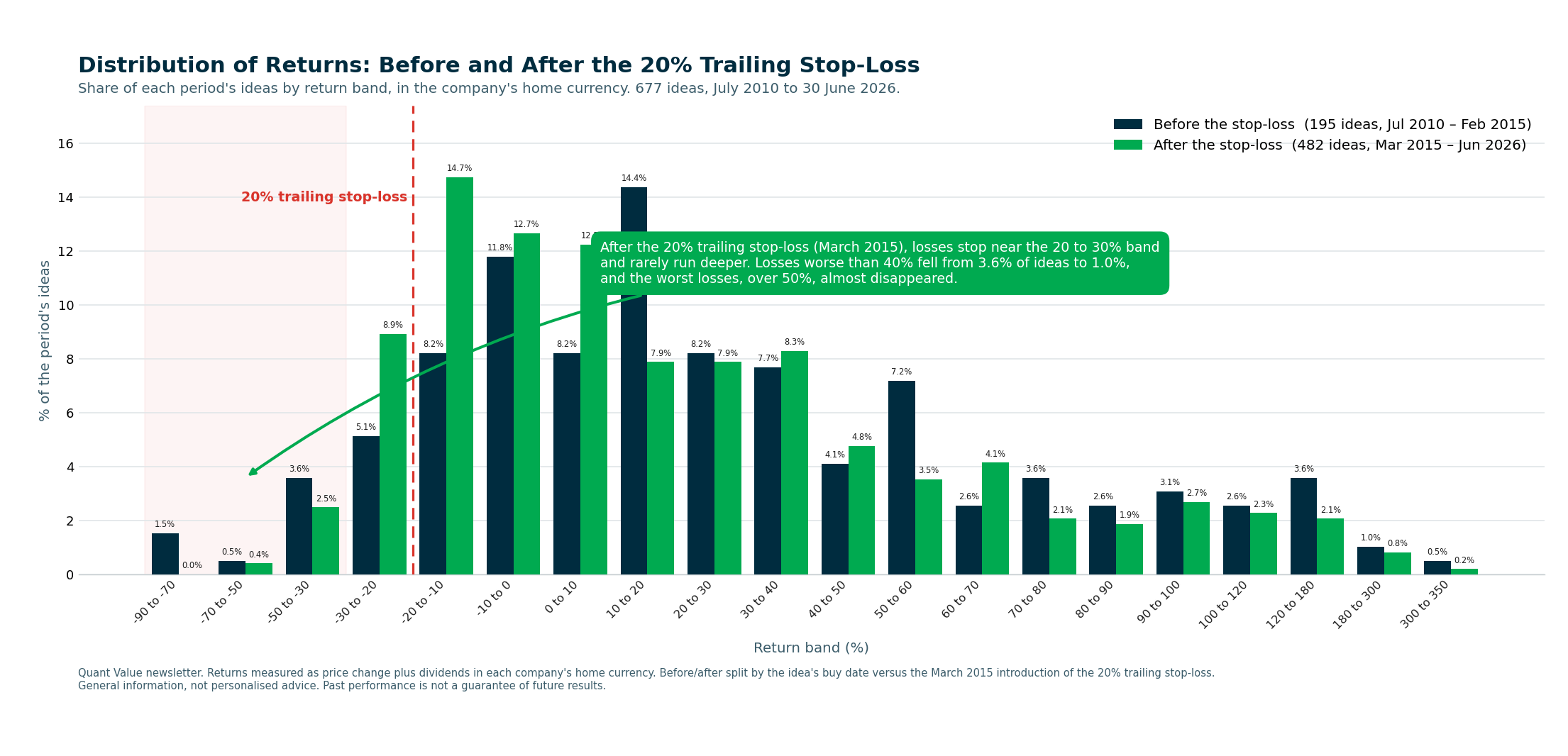
Distribution of returns before and after the 20% trailing stop-loss, as a share of each period's ideas.
Click to enlarge.
Real markets, real crashes
This is the part a back-test cannot give you. A back-test is a story told after the fact, on data chosen with hindsight. The numbers below are calendar-year returns from money that was invested, through each crash as it happened, against the World Index measured the same way.
| Crash the newsletter published through | Year | QV (€) | World (€) | QV ($) | World ($) |
|---|---|---|---|---|---|
| Eurozone sovereign-debt crisis | 2011 | +0.6% | -3.3% | -4.2% | -6.4% |
| Global Q4 sell-off | 2018 | -3.9% | -4.6% | -7.5% | -9.0% |
| COVID-19 crash | 2020 | -2.4% | +6.5% | +3.2% | +16.1% |
| Rate-shock bear market | 2022 | +0.4% | -12.9% | -8.6% | -18.1% |
In 2022, when world shares fell about 18% in dollars, the newsletter lost 8.6% and finished slightly up in euros.
In the 2011 eurozone crisis it held roughly flat while the world fell.
But 2020 went the other way: the world market bounced back from the COVID low faster than the newsletter did, and for that year the index won.
That is the trade you are making. You give up some of the fastest recoveries in exchange for far less damage on the way down. For most investors, in real money and real nerves, that is the better half of the bargain.
Consistency is the other half.
In 16 years, the newsletter has had only a handful of down years, and its worst full calendar year lost under 9% in dollars and under 4% in euros. When world markets fell much further, it fell much less.
Year by year, it has beaten the World Index in 11 of the last 15 full years, and it gave up ground mainly in the fast recovery years like 2019 and 2020.
Here it is year by year, in both currencies. The shape is the same in each. What changes is the size of the bars, because the euro and the dollar drifted apart over these years.
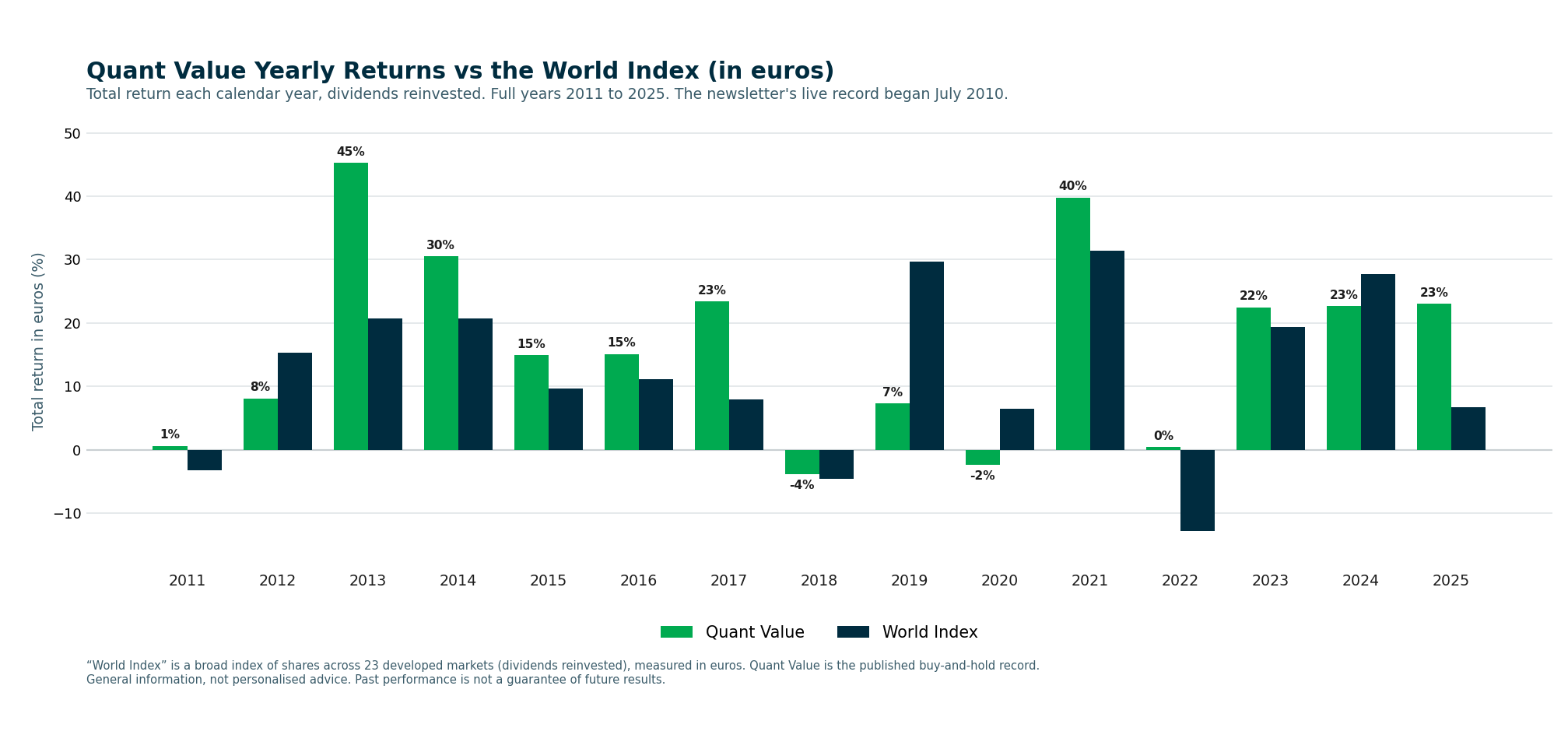
Quant Value yearly returns against the World Index, in euros, full years 2011 to 2025.
Click to enlarge.
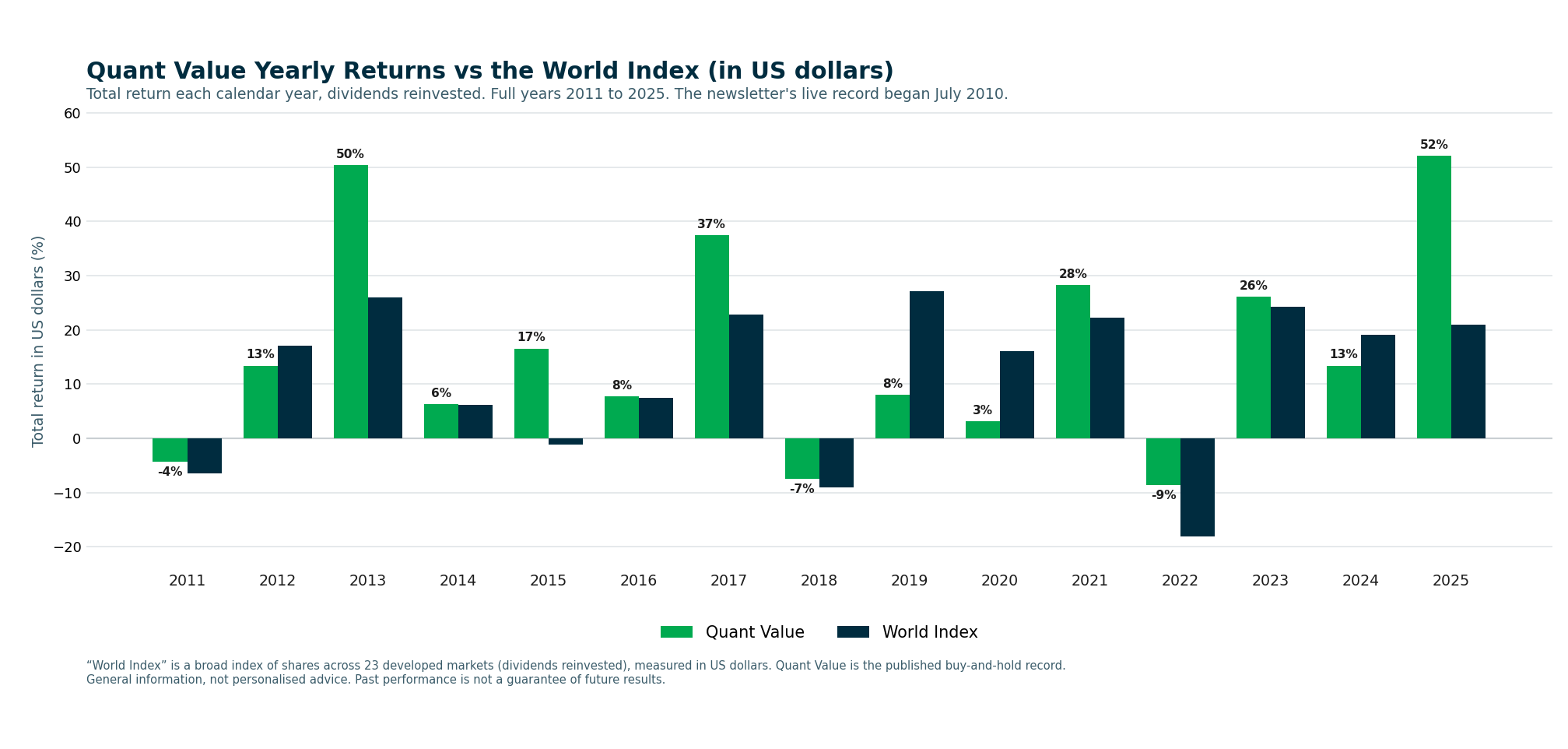
The same comparison in US dollars. Click to enlarge.
Click image to enlarge
The main difference between the two is the exchange rate, not the strategy.
When the dollar rose, as in 2014, 2015 and 2022, euro returns are lifted for both the newsletter and the index, so the euro bars sit higher.
When the dollar fell, as in 2017, 2019 and 2020, the dollar bars are the higher pair. A couple of years even change sign with the currency: the World Index was slightly negative in dollars in 2015 but positive in euros, and Quant Value was slightly negative in euros in 2020 but positive in dollars.
Which chart is yours depends on the currency you live and spend in. The result that matters, beating a broad basket of world shares in most years, holds in both.
Put the same rules to work in your own portfolio
The Quant Value newsletter sends up to six new ideas a month from Europe, Asia and North America, each with the buy price, the 2% position size and the 20% trailing stop already worked out. About 30 minutes a month to run it.
See the Quant Value subscription options
100% money-back guarantee for the first 30 days.
The good
Now the wins, measured the way we have always measured single ideas: the price change plus dividends, in each company's home currency.
| Every idea since 2010 (home currency) | Result |
|---|---|
| Investment ideas published | 677 |
| Average return per idea | +23.5% |
| Median return per idea | +12.0% |
| Ideas that made money | 63% |
| Winners vs losers (over 20%) | 3.6 to 1 |
| Best idea | +317.5% |
| Worst idea | -86.1% |
| Average holding period | about 1 year |
The average idea returned 23.5%, and most made money. The winners beat the losers by more than three to one. A handful of ideas, over the years, more than tripled.
None of it came from one lucky year or one lucky market: the ideas are spread across Europe, Asia and North America, and the record runs through 16 years of both.
What this track record is
This is the published record of a newsletter's ideas. It is general information, not personalised advice, and nothing here is a recommendation about your situation. We run these same rules in our own portfolio, every month.
Past performance is not a guarantee of future results. Prices move, and you can lose money.
Every idea is published with a 12-month time horizon. Returns include dividends and are shown before any dealing costs or tax.
World Index means a broad index of large and medium-sized company shares across 23 developed markets, measured with dividends reinvested in the currency shown; the full definition is at the foot of this page.
Start with the next Quant Value issue
You have seen the whole record, the good and the bad. If a calm, rules-based way to find global value stocks fits how you want to invest, the next monthly issue is the place to begin.
Get the Quant Value newsletter
100% money-back guarantee for the first 30 days.
What "World Index" means and how these figures were calculated
"World Index" here means a broad index ETF of large and medium-sized company shares across 23 developed stock markets, about 1,400 companies. The figures use a real, investable fund that tracks it, with dividends reinvested after withholding tax, priced in US dollars and converted to euros at daily exchange rates, over 1 July 2010 to 30 June 2026.
Using a real fund makes the comparison like-for-like with the newsletter: both include dividends, both are what an investor could have held. Newsletter figures are the published buy-and-hold record: each idea bought at a 2% starting position on the issue date, sold on the sell date, dividends reinvested, no new buys while a region's market is below its 200-day average, converted to each currency at daily rates. Figures are before dealing costs and tax.